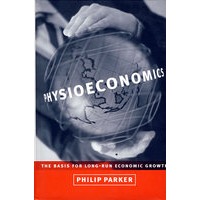
| According to Philip Parker, the relationship between physics-based physiology and macroeconomics may come to dominate explanations of economic growth. His argument focuses on the so-called equatorial paradox--the phenomenon that a country's latitude explains up to 70 percent of cross-country variances in per capita income. After introducing concepts from physics and physiology as the building blocks of homeostatic utility, he explains the role of homeostatic utility in economic growth. Specifically, he shows that a country's performance is gauged not by its absolute level of income or consumption, but by how far it is from a homeostatic steady state governed by what he calls physioeconomics. Countries closer to their homeostatic steady state grow more slowly than those farther away. Parker shows how factors such as income, aggregate savings, investment, technology, entrepreneurship, production, and outputs per worker are influenced by the more fundamental principles of physics and physiology. He focuses particularly on the hypothalamus, the part of the brain that drives motivation, monitors homeostasis, and ultimately keeps us alive via neural, autonomic, and hormonal adjustments. He presents evidence that long-run growth can be attributed to variances in hypothalmic activity. A physioeconomic approach to growth can lead to better economic policies, measures of performance, and predictions of progress. To take just one example, policymakers would be quicker to realize that food aid to warmer regions can destroy local farming economies that supply adequate |




 内容加载中,请稍后...




商品评论(0条)