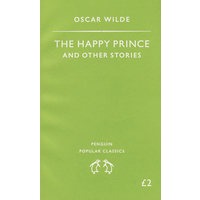
| 作者简介: OSCAR WILDE (I854-I9OO). Playwright, poet, essayist, and wit, he is now as famous for his flamboyant lifestyle and epigrams as for his plays, poems and fiction. Oscar Fingal O'Flahertie Wills Wilde was born in 1854 in Dublin. His father was the eminent surgeon Sir William Wilde and his mother a literary hostess who was also known as a writer under her pen name 'Speranza'. Studying classics first at Trinity College in Dublin, before going on to Magdalen College, Oxford, Wilde proved to be a brilliant scholar, winning the Newdigate Prize for his poem 'Ravenna'. While at Oxford, his flamboyant appearance and conspicuous espousal of Aestheticism - art for art's sake - attracted a lot of attention, much of it hostile. With his talent, wit, charm and instinct for publicity, Wilde soon became a familiar name in the literary world, as much for his conversational skills as for his writing. His first collection, Poems, was published in 1881, shortly before he embarked on a one-year lecture tour of North America. Arriving in New York Wilde is recorded as saying 'I have nothing to declare but my genius' - one of the many epigrams attributed to him. Following his marriage to Constance Lloyd in 1884, he published several books of stories for children, Originally written for his own sons. Lord Arthur Savile's Crime appeared shortly before his only novel, The Picture of Dorian Gray (1891). After 189~ Wilde had increasing success on stage with his shrewd and sparkling comedies, Lady Windermere's Fan (1892), A Woman of No Importance (1893), An Ideal Husband (1895) and his masterpiece, The Importance of Being Earnest (1895). Wilde's play, Salome, written in French, was refused a licence in London but was performed in Paris in 1896 and later adapted as an opera by Richard Strauss. Translated by Wilde's close friend Lord Alfred Douglas ('Bosie'), it appeared for publication in England withillustrations by Aubrey Beardsley. Douglas's father, the Marquess of Queensberry, strongly disapproved of his son's friendship with the notorious playwright and after he publicly insulted Wilde, a quarrel ensued that eventually led to Wilde's trial and conviction in 1895 for homosexual offences. He was sentenced to two years imprisonment with hard labour, which left him bankrupt and weakened on his release in I897. Relying on the generosity of ftiends he went to live in France, adopting the name of Sebastian Melmoth, where he wrote his most famous poem, The Ballad of Reading Gaol. Wilde died in exile in France in 1900. Letters he had written to Lord Alfred while in prison were published in 19o5 under the title De Profundis. 'The Happy Prince' is one of Wilde's best-known stories for children. He first told the story to a group of friends at Cambridge in 1885, and because it was so well friends at Cambridge in Igg5, and because it was so well received he wrote it down on his arrival home, regaling his sons with this and other stories when they were old enough. When The Happy Prince and Other Stories' was published in 1888 the Athanaeum made comparisons with Hans Christian Andersen. Among the stories included in this collection are 'The Selfish Giant', 'The Devoted Friend' and 'The Young King', all of which remain as cherished today as they were by his own sons over a hundred years ago. Readers may also find the following books of interest: Neff Bartlett, Who was That Man? (1992); K. Beckson (ed.), Wilde: The Critical Heritage (197o); Richard Ellmann, Oscar Wilde (1987); H. Montgomery Hyde, Oscar Wilde: A Biography (1976); R. Shewan, Oscar Wilde: Art and Egotism (1977); and P. Raby, Oscar Wilde (1988). |
| THE HAPPY PRINCE The Happy Prince The Nightingale and the Rose The Selfish Giant The Devoted Friend The Remarkable Rocket A HOUSE OF POMEGRANATES The Young King The Birthday of the Infanta The Fisherman and His Soul The Star-Child |


 内容加载中,请稍后...



商品评论(0条)