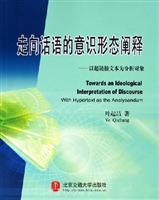
| 叶起昌,1958年2月生,文学博士,北京交通大学人文社会科学学院副教授。1980年毕业于福建宁德师范专科学校英语系。1980一l 992年在福建屏南一中任英语教师。1992—1995年在福建师范大学外国语学院学习,获文学硕士学位。1995—2001年任福建广播电视大学英语讲师、副教授。200l一2004年在北京师范大学攻读博士学位,在读期间连续两年被评为优秀博士生。曾在国内外不同刊物发表论文数十篇。目前研究方向涉及意识形态研究、(社会)符号学、哲学阐释学与语篇理解、系统功能语言学、话语分析、后印刷时代的读写、国外语言学理论和流派等。 |
| Chapter 1 An Introduction:Some Basic Terms 1.0 Introduction 1.1 The Etymology of“Discourse”and That of“Text” 1.2 The Terms“Discourse”and“Text”in the Current Situation 1.3 Why Study Ideology? 1.4 What Does“Critical”Mean(in CDA)? 1.5 The Purpose of T11is Study 1.6 The Guideline for This Study 1.7 The Content Of TIliS Book 1.8 A Possible Analytical Frame Chapter 2 CDA Research Survey 2.0 Introduction 2.1 The Background of CDA and Its Initial Stage 2.2 Three Basic Models 2.3 CDA in Its Developing Stage 2.4 “Discursive Formation” 2.5 Social Semiotics 2.6 Thibault’s(1991)Study 2.7 Sociocultural Change and Change in Discourse 2.8 CDA in 90s and the Early 21st Century 2.9 “Discourse in Late Modernity” Chapter 3 Ricoeur’S Conception of Ideology 3.0 Introduction 3.1 Ricoeur’S Intellectual Development 3.2 The Introduction to Ricoeur’S Theory of Ideology 3.3 Summary Chapter4 Hypertext and a Critical Analysis of Its Discursive Characteristics 4.0 Inuoducfion 4.1 Hypertext 4.2 The Order of Discourse and the Technologisation of Discourse 4.3 The Concept of“Text”in Hypertext 4.4 Hypertext.Power and Control 4.5 Summary Chapter 5“How Do You Know?” 5.0 Introducfion 5.1 What Saussure’S Model of Signs Implicates for the Relationships Between Word and Image 5.2 The Discrepancies Between Word and Image in Peirce’s Model of Sign 5.3 CDA’s AttitUde Towards These Two Models 5.4 The Relationship(S)Between Word and Image 5.5 Can Images Lie? 5.6 Lakoff et a1.’S Study as an Evidenee for CDA 5.7 The Characters of Visual Communication” 5.8 How Do We Read the Screen? 5.9 Summary Chapter 6 Virtual Reality——the World on the Screen 6.0 Introduction 6.1 What Is VR? 6.2 The Importance of the Embodiment 6.3 The History of Media and the Three Major Technological Transformations of Information Transportation.Storage and Retrieval 6.4 The Constraints on the User of Hypertext(the Net) 6.5、Ⅳhat Are Differences Between the Texts Shown on the Screen and the Letters in the Book 6.6 Socializing Technology 6.7 The Materiality of Media 6.8 Summary Chapter 7 Hypertext and Intertextuality 7.0 Introduction 7.1 Tlle Origin(s)of Intertextuality 7.2 No Text Is an Island 7.3 Defining Features of Intertextuality 7.4 Order of Discourse and Intertextuality 7.5 Intertextuality and Coherence 7.6 Hypertext and Transformation 7.7 Summary Chapter 8 Hypertext and Literacy 8.0 Introduction 8.1 What Is Literacy in the New Media Age? 8.2 Characterizing Hypertextual Literacy 8.3 Three Further Effects of New Technologies 8.4 What Leads to Hypertext Literacy 8.5 The Major Differences Between the World Told and the Wodd Shown 8.6 Reading as Semiosis 8.7 Semiotic Resources(Available Designs),Designing and Redesigned 8.8 Technologies Function as Ideological Tools(on Four Intertwined Themes) 8.9 ne Place of Critique in Hypertext Literacy Chapter 9 Multimodality and Hypertext 9.0 Introduction 9.1 Mode and Multimodality 9.2 CDA’S Account of Hypertext in Terms of Multimodality 9.3 The Three Requirements of Communication and the ThEee Interrelated Systems:Information Value,Salience and Framing 9.4 A Case Study 9.5 Summary Chapter 10 A Short Conclusion 10.1 An Inescapable Fact 10.2 An Antidote to False Optimism and Unrealistic Expectation Clouding VR 10.3 Understanding Should Be Socially Situated。 10.4 The Paradox of Understanding。 10.5 The Ultimate Aim of Understanding Hypertext Is to Understand Ourselves Bibliography |


 内容加载中,请稍后...



商品评论(0条)